X It Off vs Monday.com
This detailed X It Off vs Monday.com comparison breaks down the difference between personal execution systems and team project management software so you can choose the right tool in 2026.
If you are comparing X It Off vs Monday.com, you are likely trying to answer a simple but important question: which productivity system will actually help you get things done consistently?
While both platforms improve productivity, they are built for very different purposes.
If you are also evaluating other task management tools, you may find our comparison of X It Off vs Todoist helpful.
Understanding that difference is critical.
X It Off vs Monday.com at a Glance
If you need quick clarity, here is the core difference:
• X It Off is built for personal execution and overcoming procrastination.
• Monday.com is built for team workflow management and collaboration.
Both tools improve productivity, but they solve different problems.
What Is Monday.com?
Monday.com is a cloud-based work operating system designed for teams. You can learn more about their platform directly on the official Monday.com website.
It helps organizations manage:
• Projects
• Timelines
• Workflows
• Team collaboration
• Resource tracking
• Client pipelines
It is excellent for structured team environments where visibility and coordination are priorities.
However, it was not built primarily as a psychological execution tool for individuals.
What Is X It Off?
X It Off is a personal execution system designed to eliminate procrastination at the behavioral level.
It focuses on:
• Reducing emotional resistance
• Structuring action clarity
• Breaking mental friction
• Converting intention into execution
• Creating momentum through micro action
It is built around how individuals actually think, hesitate, and avoid.
Not just how teams manage tasks.
Core Difference: Management vs Execution
Monday.com is a management platform.
X It Off is an execution system.
Management organizes work.
Execution moves work forward.
If you manage a team, track deadlines, and assign responsibilities, Monday.com excels.
If you struggle to start, hesitate, overthink, or feel overwhelmed, X It Off addresses the root issue.
Key Differences Between X It Off vs Monday.com
The main difference between X It Off vs Monday.com comes down to purpose and design philosophy.
Monday.com is structured around team collaboration, workflow visibility, and project oversight.
X It Off is structured around personal execution, behavioral activation, and reducing procrastination.
If you are searching for a Monday.com alternative focused specifically on individual productivity, understanding these differences is essential.
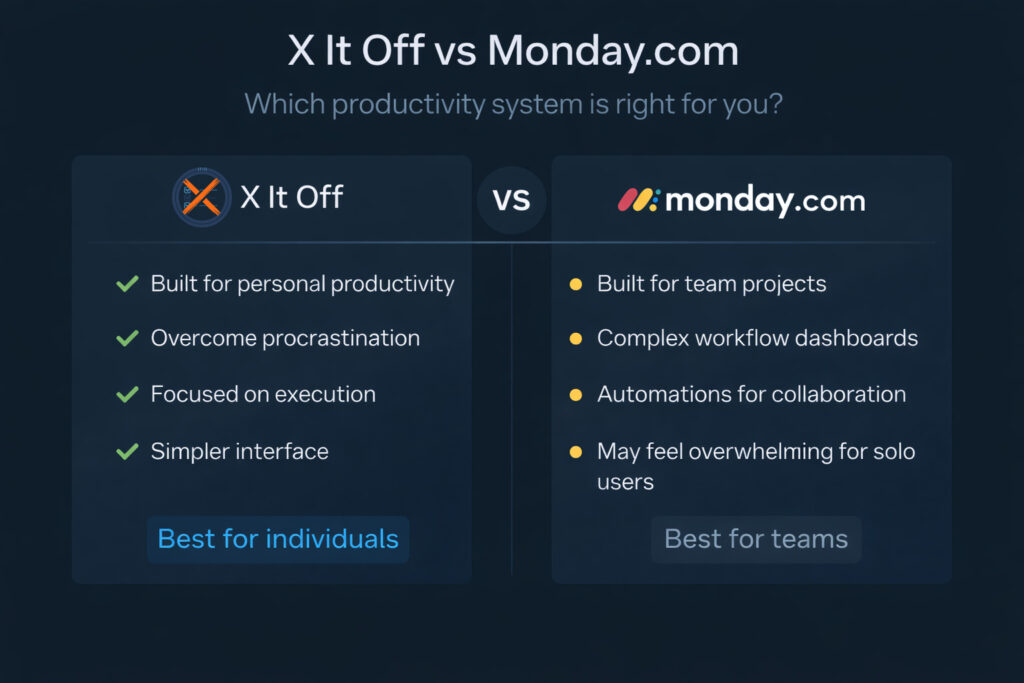
Feature Comparison
1. Designed For
Monday.com
Teams, agencies, startups, enterprises
X It Off
Individuals, creators, entrepreneurs, students, high performers
2. Focus
Monday.com
Workflow management and collaboration
X It Off
Psychological friction reduction and action activation
3. Interface Philosophy
Monday.com
Boards, columns, automation, dashboards
X It Off
Vision-based execution design centered around structured task progression
4. Emotional Design
Monday.com
Neutral professional interface
X It Off
Built intentionally to combat hesitation and overwhelm
5. Use Case Clarity
Choose Monday.com if:
• You manage multiple team members
• You need shared boards
• You track cross-functional workflows
Choose X It Off if:
• You struggle with starting tasks
• You want a personal execution system
• You want structure without enterprise complexity
When comparing X It Off vs Monday.com, it becomes clear that the two platforms are not direct competitors in the traditional sense. One focuses on organizational visibility, while the other focuses on behavioral execution. Choosing the right system depends on whether your bottleneck is coordination or personal follow-through.
Is Monday.com Good for Personal Productivity?
Yes, but with limitations.
Monday.com can be used individually, but it was built for teams first.
For solo users, it may feel heavier than necessary.
It excels in visibility and coordination, not behavioral activation.
If your challenge is procrastination rather than project oversight, understanding why many traditional productivity tools fail can clarify what type of system you truly need.
When X It Off Makes More Sense
X It Off is ideal if:
• You delay important work
• You start projects but rarely finish
• You feel overwhelmed by traditional task lists
• You want clarity without corporate structure
It does not try to manage a team.
It focuses on making sure you move.
Is X It Off a Monday.com Alternative?
If you are searching for a Monday.com alternative, the answer depends on what type of productivity system you need.
For team-based project coordination, Monday.com is built for structured collaboration.
For individuals who struggle with starting, finishing, or maintaining momentum, X It Off functions as a focused execution system rather than a workflow management platform.
Which Should You Choose?
Choosing between X It Off and Monday.com depends on what problem you are trying to solve.
If you manage teams, oversee complex workflows, or need structured collaboration tools, Monday.com is a strong project management platform.
If your challenge is starting tasks, overcoming procrastination, and building consistent personal momentum, X It Off was designed specifically for that purpose.
Both tools improve productivity.
But they improve different types of productivity.
Understanding your real friction point is the key to choosing the right system.
Explore X It Off
If you are looking for a productivity system built around execution rather than workflow management, explore how X It Off is designed to reduce friction and activate consistent action.
Learn how X It Off works as a personal execution system →
This X It Off vs Monday.com comparison is designed to help you choose the right productivity system based on how you actually work.
Frequently Asked Questions
If you are researching X It Off vs Monday.com, these common questions may help clarify which productivity system fits your needs.
Is X It Off better than Monday.com for personal productivity?
It depends on your goal. Monday.com is built primarily for team collaboration and project management, while X It Off is designed as a personal execution system. If you need structured team workflows, Monday.com is strong. If your challenge is procrastination, hesitation, or starting tasks consistently, X It Off is built specifically for individual execution.
Can Monday.com be used for personal productivity?
Yes, Monday.com can be used by individuals. However, it was originally designed for team environments. Solo users may find that many features focus on collaboration, dashboards, and workflow management rather than personal task activation.
What is the best alternative to Monday.com for individuals?
If you are looking for a system focused on personal execution rather than team coordination, X It Off is a strong alternative. It is designed specifically to reduce mental friction and help individuals move from intention to action.
Is Monday.com good for managing daily tasks?
Monday.com can manage daily tasks effectively, especially within structured projects. However, it functions best when tasks are part of a broader team workflow rather than as a lightweight personal task system.
What makes X It Off different from project management software?
Project management software focuses on organizing and tracking work. X It Off focuses on overcoming resistance and activating consistent execution. It is built around behavioral psychology rather than workflow administration.
Is Monday.com better for teams than X It Off?
Yes. Monday.com is built for team collaboration, shared boards, and cross functional workflows. X It Off is not designed to manage teams. It is built for individuals who want to improve personal productivity and eliminate procrastination.
Which tool is better for overcoming procrastination?
If procrastination is the core issue, a system designed around behavioral activation is typically more effective than a team project management platform. X It Off was created specifically to address hesitation, overwhelm, and task avoidance at the individual level.