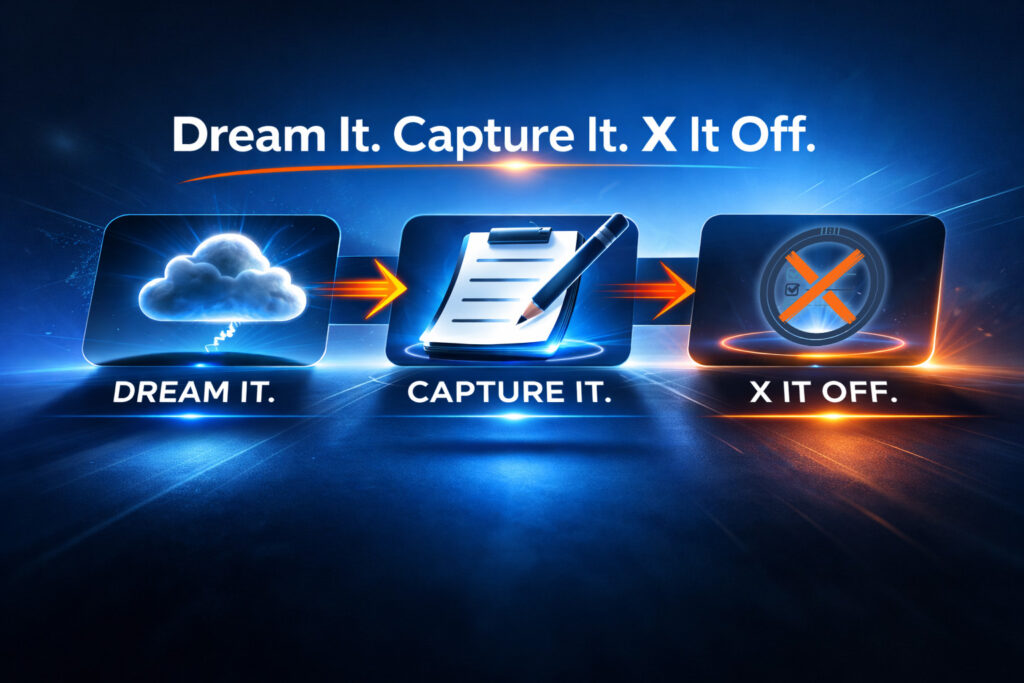
Dream It. Capture It. X It Off. defines the three execution stages built directly into the X It Off system. Together, they guide users from vision to structured action and ultimately to visible completion within the platform.
Dream It.
Every meaningful result begins as a dream.
A business you want to launch.
A healthier body.
A financial breakthrough.
A restored relationship.
A book you have always meant to write.
A kitchen that needs cleaning.
A leaky faucet that needs repair.
A fence that needs painted.
Dreaming is not the problem.
Most people dream constantly.
The problem is that dreams remain abstract.
Without structure, they create pressure instead of progress.
X It Off begins at the dream level because execution does not start with tasks. It starts with intention.
Capture It.
Capture It does not happen in theory. It happens inside the X It Off system.
The moment a user enters the Capture Phase and releases a task, goal, or dream into the platform, the mental weight shifts. The overwhelm is no longer carried internally. It is transferred into engineered structure.
When an idea stays in your head, it expands. It feels massive. Undefined. Heavy.
Inside X It Off, Capture It is the point where that mass is broken down.
The system does not simply store the task.
It deconstructs it.
It restructures it.
It reduces it to the smallest actionable unit.
The user no longer sees the entire brick wall.
They see one brick.
One step.
One controlled action.
If the task is “Clean the kitchen,” the system is designed to not overwhelm the user with the entire kitchen for long. Instead, it gradually narrows focus to something immediately executable, such as “Wash one spoon.”
That shift changes everything.
Overwhelm collapses.
Resistance weakens.
Action becomes manageable.
X It Off is designed to detect friction. When hesitation appears, the system responds by reducing scope. It continues shrinking the task until movement becomes easier than avoidance.
The platform determines what matters first. It orders the progression. It presents only what can be handled now. The exhausting mental work of deciding, prioritizing, and breaking things down is handled by the system itself.
This is not a digital checklist.
It is controlled exposure to progress.
The user does not confront the entire structure at once.
They place one brick.
Then the next.
Then the next.
Capture It is the decisive moment where the burden shifts from willpower to system design. Once something is captured, it is no longer dependent on motivation. The system begins carrying the cognitive load.
Inside X It Off, Capture It is not a note.
It is activation.
X It Off.
Execution is not about pressure.
It is about completion.
The “X” is not decorative. It is decisive.
A checkmark suggests acknowledgment. An X signifies finality. It crosses through something. It closes it.
Inside X It Off, the gesture matters.
When you draw an X across a task, your finger moves in one direction, then cuts back in the opposite direction to cross through it. The motion interrupts the line itself. The task is not approved. It is eliminated.
The brain responds to visible completion.
When something is crossed off, neural reward circuits activate. Dopamine is released. Research in behavioral neuroscience has shown that visible progress activates the brain’s reward system. The brain registers success. That signal reinforces the behavior that created it.
Completion feels satisfying.
Satisfaction builds momentum.
Momentum reduces hesitation.
Each X strengthens the loop.
The system deliberately surfaces tasks in an order designed to sustain forward motion. When the next step appears, it is executable. When it is crossed off, the brain marks progress again.
Signal.
Reward.
Repeat.
Over time, follow-through becomes easier because the mind associates action with closure.
X It Off is not about checking boxes.
It is about crossing through resistance.
It is about conditioning execution.
Inside the system, every X is a visible declaration:
Done.
And the brain accepts it.
Why This Sequence Matters
Most productivity tools start at organization, including traditional task managers like Todoist.
Too often, they end in overwhelm and frustration.
X It Off starts earlier.
It is designed to finish what you start.
It is built to make you start, because nothing can be finished if it never begins.
It recognizes that procrastination does not begin at the task level. It begins earlier, in the psychological space before action.
It begins in the space between intention and action, before anything is captured or structured.
Dream It.
Capture It.
X It Off.
That sequence is intentional.
It closes the space where hesitation forms.
It eliminates friction before friction has time to expand.
Execution does not fail at completion.
It fails at the start.
X It Off is built to protect that start and carry it through to completion.
Finish What You Start.
The Meaning of the X
The X is symbolic.
It represents:
• Finality
• Commitment
• Elimination of delay
• A decisive mark
• Completion
• Success
The X is not decorative.
It is behavioral reinforcement.
Historically, the X has also carried sacred meaning. In early Christian tradition, the Greek letter Chi (Χ) represented Jesus Christ. For many believers, Jesus symbolizes completion and fulfillment.
For many, it is also a reminder of the call to finish what has been started.
“As for you, be strong and do not give up, for your work will be rewarded.” — 2 Chronicles 15:7
The act of crossing something off is neurologically powerful.
X It Off is built around that principle.
Not Motivation, A System
Dream It. Capture It. X It Off. is not motivational language.
It is structural psychology.
It is a deliberate system designed to convert vision into execution.
This phrase does not inspire action.
It structures it.
It defines how X It Off works.
It is the identity of the system.
Frequently Asked Questions
What does “Dream It. Capture It. X It Off.” mean?
Dream It. Capture It. X It Off. defines the three-stage execution sequence built into the X It Off system. It moves users from vision, to structured activation, to visible completion. It is not a motivational phrase. It is the operational framework of the platform.
Is Dream It. Capture It. X It Off. just a slogan?
No. While it reads like a slogan, it represents the structural psychology behind how X It Off works. Each stage corresponds to a specific system behavior inside the platform. The phrase describes the architecture of execution, not inspiration alone.
How does Capture It reduce procrastination?
Capture It transfers a task from mental overload into engineered structure. Once entered into X It Off, the system narrows focus, prioritizes progression, and reduces exposure to overwhelm. The user no longer faces the entire task at once. They face the next executable step.
Why is the X gesture important?
The X gesture reinforces completion. Crossing through a task creates a visible interruption that signals closure to the brain. This activates reward pathways and strengthens follow-through over time. The gesture is designed to condition execution through repetition.
How is X It Off different from traditional task managers?
Traditional task managers focus on organization. X It Off focuses on activation. It is designed to help users start tasks when resistance is present and to guide them through completion using structured progression and visible reinforcement.
Who is Dream It. Capture It. X It Off. designed for?
The system is designed for people who struggle to start, even when they know what needs to be done. It supports vision-driven individuals who experience hesitation, overwhelm, or delay between intention and action.
Can Dream It. Capture It. X It Off. work without motivation?
Yes. The system is built to reduce dependence on motivation. By structuring the path from dream to completion, it minimizes the psychological friction that prevents progress. Execution becomes a function of design rather than emotional readiness.