Why Organization Doesn’t Guarantee Action
Most productivity apps focus on organizing tasks, but organization alone does not reduce the resistance people feel at the moment of starting. Execution requires structure that makes the first step feel clear and manageable.
Organization Doesn’t Solve the Starting Problem
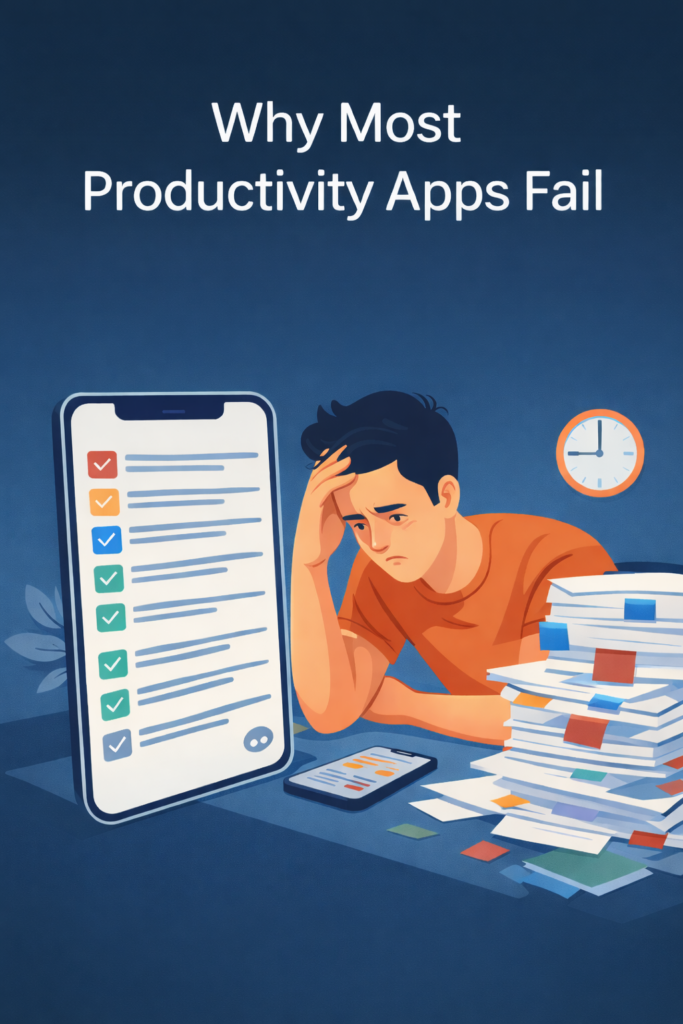
Why most productivity apps fail is not because they lack features.
Most productivity apps are designed to help you stay organized.
They give you task lists, reminders, folders, priorities, due dates, labels, tags, filters, dashboards, timelines, and notifications.
On paper, this sounds helpful.
In reality, millions of people still struggle to begin the tasks they know they should be doing.
The problem is not awareness.
The problem is not remembering.
The problem is starting.
This is one of the core reasons why most productivity apps fail to help people take action consistently.
Many people already know exactly what they need to do.
The difficulty appears at the moment when action is required, which is why many people struggle with starting tasks even when they want to make progress.
That moment is where most productivity systems quietly fail.
Organization is not the same as execution
Traditional productivity tools are built around the idea that organization leads to action.
The assumption is simple:
If tasks are clearly listed, people will complete them.
But real human behavior is not that simple.
People create lists every day.
They organize projects.
They schedule deadlines.
They categorize responsibilities.
They prioritize what matters.
And yet, important tasks still get delayed.
Not because people forgot.
But because beginning felt harder than expected.
Organization helps you see what needs to be done.
It does not always help you do it.
The invisible barrier before action
There is a psychological moment that occurs between planning a task and starting a task.
It is a small moment, but it has enormous influence over outcomes.
This moment often includes thoughts like:
I should start this now
I know this is important
This will take effort
I don’t feel ready
Maybe I’ll start later
Nothing is technically preventing action.
But something internally slows movement forward.
This is the friction most productivity tools ignore.
The assumption is that once tasks are visible, action will follow naturally.
But awareness does not remove resistance.
Why starting often feels harder than finishing
Interestingly, many people find that once they begin a task, continuing becomes easier.
Momentum starts to build.
Clarity increases.
Uncertainty decreases.
Progress becomes visible.
But reaching that first step often feels disproportionately difficult.
This happens because the brain is attempting to evaluate:
How difficult will this be?
How long will this take?
Will I succeed?
Will I fail?
Is this the right approach?
Am I ready?
Large tasks contain many unknowns.
Unknowns create hesitation.
Hesitation delays action.
Delay increases pressure.
Pressure increases avoidance.
Avoidance reinforces procrastination, which is why understanding why people procrastinate helps explain why organization alone does not always lead to action.
This cycle can repeat even when the person genuinely wants to make progress.
The limitation of reminder-based systems
Many productivity apps attempt to solve procrastination through reminders.
Reminders are useful for awareness.
But reminders do not always reduce hesitation.
A reminder can tell you when something should happen.
It does not always make the task feel easier to begin.
Notifications can even increase stress when unfinished tasks accumulate.
Repeated reminders can create a growing sense of pressure.
Pressure alone does not produce clarity.
Clarity is what allows action to begin.
When tasks feel too large to approach
Many responsibilities are not single-step actions.
They are collections of multiple smaller actions.
Examples include:
Start a business
Clean the house
Improve health
Write a book
Organize finances
Build a portfolio
Prepare for a career change
These goals are meaningful, but they are also complex.
When a task feels large or undefined, the brain struggles to identify the first step.
Without a clear first step, hesitation increases.
The more important the task feels, the more pressure can build around starting it.
This pressure can cause avoidance even when the person deeply cares about the outcome.
The motivation myth
A common belief is that motivation must exist before action can begin.
Many people wait to feel ready before starting.
But motivation is often inconsistent.
Motivation can fluctuate based on:
energy levels
stress levels
uncertainty
environment
emotional state
competing priorities
If productivity depends entirely on motivation, consistency becomes difficult.
Motivation is helpful when it appears.
But relying on motivation alone creates instability.
Structure provides a more reliable foundation for action.
The gap between intention and action
Most people do not struggle with intention.
They struggle with execution.
Intentions exist in abundance.
People want to improve their health.
They want to complete projects.
They want to follow through on commitments.
They want to make progress.
But intentions alone do not produce results.
Action produces results.
The challenge is bridging the gap between knowing and doing.
This gap is where many productivity tools fall short.
It highlights why most productivity apps fail, even when they offer advanced features and organization tools.
They help define what should be done.
But they do not always help make beginning feel manageable.
Why clarity reduces resistance
Clarity changes how a task feels.
When the next step is clearly defined, action becomes easier to approach.
Instead of confronting an entire project at once, the focus shifts to one small movement forward.
For example:
Instead of:
Write book
The next step might be:
Write one paragraph
Create outline headings
Open document
Instead of:
Clean house
The next step might be:
Put dishes in sink
Clear one counter
Start laundry
These smaller steps feel more approachable.
Approachable tasks create less resistance.
Less resistance increases the likelihood of starting.
Starting creates momentum.
Momentum encourages continuation.
Progress creates confidence
Each completed step reinforces the belief that progress is possible.
Small progress compounds over time.
Small progress builds consistency.
Consistency builds trust in oneself.
Trust increases willingness to begin future tasks.
When people begin to experience completion more frequently, productivity becomes less intimidating.
The focus shifts from managing tasks to moving forward.
A structural approach to productivity
Instead of assuming organization automatically leads to execution, a structural approach focuses on reducing friction at the moment of action.
The goal is not simply to collect tasks.
The goal is to support forward movement.
Structure can guide attention toward the next step instead of presenting the entire workload at once.
This reduces overwhelm.
Reducing overwhelm reduces avoidance.
Reducing avoidance increases progress.
Why starting changes everything
Beginning a task often changes the emotional experience of the task.
What once felt difficult begins to feel manageable.
What once felt unclear begins to feel defined.
What once felt distant begins to feel possible.
Starting does not guarantee instant completion.
But without starting, completion cannot occur.
The ability to begin consistently is one of the most valuable skills in any productivity system.
A different design philosophy
X It Off was created around a simple idea: helping people reduce friction at the moment of starting so progress becomes easier and more consistent.
Starting is the most fragile moment in the productivity process.
Many systems optimize organization.
Few systems optimize beginning.
When systems are designed to reduce friction at the moment of action, behavior begins to change.
Tasks feel more approachable.
Progress becomes more consistent.
Completion becomes more frequent.
Confidence grows.
Momentum builds.
Results follow.
Finishing what you start begins with starting
People often believe productivity improves when they become more disciplined.
In many cases, productivity improves when tasks become easier to approach.
Reducing friction does not remove responsibility.
It removes unnecessary resistance.
When resistance is reduced, action becomes more likely.
When action becomes more likely, progress becomes more consistent.
When progress becomes consistent, meaningful goals become achievable.
Finishing what you start is not only about persistence.
It is also about structure.
Because starting is the first step toward finishing.
And systems that help people start can change what they believe is possible.